
Positive Trends in Card Spending, Online Gambling and Predictions Markets: Velera Payments Index

By Roy Urrico

August card spending growth reflected a continued positive trend in consumer engagement, according to the September edition of the Velera Payments Index. The report also revealed debit purchase continued to outperform credit purchase growth, which still remained positive, but declined from recent highs. Spending in August was supported by back-to-school shopping and elevated gasoline prices.

St. Petersburg, Fla.-based Velera, which describes itself as the nation’s premier payments CUSO, produces the Velera Payments Index to help credit unions and other financial institutions make strategic, data-informed decisions.
September’s Payments Index also took a deep dive into the rapid growth of online gambling and prediction markets, including their rising popularity among younger consumers and the implications for financial wellness, fraud prevention and member education.
“Online gambling and prediction markets are a small share of overall card activity, but they’re moving into the mainstream faster than many financial institutions expected, particularly among younger consumers,” said Karen Postma, Senior Vice President, Risk Solutions, Velera.
Key Takeaways from the Payments Index
Consumer spending continued to show strength in August, with debit purchases increasing 6.1% year over year, supported by 3.4% growth in transactions. Purchase growth continued to be driven by the money services, goods and gasoline sectors. Credit purchases rose 3.6% year over year, with transaction growth of 2.8%. The gasoline sector returned as the leading contributor to credit purchase growth, followed by goods and services.
Consumer confidence indicators softened in August, reflecting ongoing uncertainty related to gasoline prices and tariffs. The University of Michigan’s Index of Consumer Sentiment fell to 51.7, down 6.3% from July and marking its second consecutive monthly decline. “Higher gas prices and concerns over tariffs were the most frequently cited factors among survey respondents,” said the Payments Index. Consumer sentiment remained 13% below its level from a year ago. Similarly, the Conference Board’s Consumer Confidence Index fell 0.8 points to 89.4, down from 90.2 in July.
The Bureau of Labor Statistics (BLS) reported a gain of 162,000 jobs in August. The ADP jobs report showed private-sector payrolls increased by 38,000 jobs, “with hiring slowing to the lowest rate since January.” Gains were concentrated in education, health care, construction and leisure and hospitality services, while employment declined in manufacturing, as well as professional services and information.
Inflation trends moved in a less favorable direction for consumers than in prior months. The U.S. Consumer Price Index (CPI) rose 0.4%, bringing the 12-month annual inflation rate to 3.4%, unchanged from July. Gasoline was the primary driver of monthly inflation, accounting for over one-third of the increase. Energy, shelter and food away from home also posted notable gains. Core CPI, which excludes food and energy, increased 0.3% in August after increasing 0.2% in July.

Deep Dive: Gambling and Prediction Markets
“Online gambling and prediction markets represent a rapidly growing category of consumer payment activity that sits at the intersection of payments, financial wellness, fraud and regulatory oversight,” stated the Payments Index in its “Deep Dive” section. “While these transactions still account for a small share of overall card volume, growth rates significantly exceed broader consumer spending trends – particularly among younger consumers.”
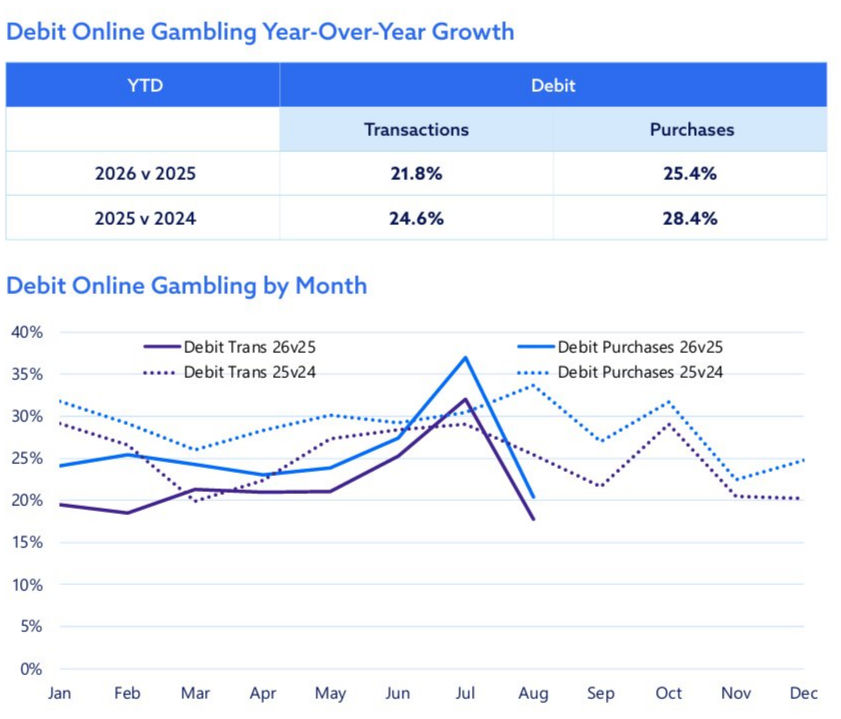
Through August, which included the FIFA World Cup held throughout North America from June 11 to July 19, online gambling debit transactions and purchases were up 21.8% and 25.4%, respectively, year over year. However, both transactions and purchases are still down approximately 3% from the previous year-over-year growth, despite the noticeable lift from the World Cup.
“Once illegal except in certain physical locations in the U.S., online sports betting continues to grow as additional states consider legislative measures to allow it within their borders,” the report maintained. Since March 2025, the number of states that permit either online or in-person sports betting has increased from 39 to 40, according to the American Gaming Association, with Missouri recently joining the group and offering both in-person and online sports betting. Currently, Georgia and Hawaii are considering adoption as well.
Generation Z accounted for nearly two-thirds of the year-to-date prediction market debit transactions and purchases, yet had the lowest average wagers among generational segments. Kalshi represented 88% of all prediction market debit transactions year to date, but had the lowest average purchase amount.
“The concentration of prediction market activity among Gen Z, combined with evolving regulation and the potential for market manipulation, creates new considerations for fraud prevention, member education and financial wellness,” Postma explained. “Credit unions need to understand what’s showing up in member activity so they can identify emerging risks, educate members and make sure their fraud strategies can keep pace as these markets evolve.”
Prediction market activity is currently experiencing an explosion, with annual trading volumes on track to reach an estimated $410 billion in 2026, according to TradingView. Weekly prediction market debit transactions and purchases steadily increased throughout 2026, culminating in an enormous surge in activity leading up to the World Cup.
“Prediction markets and gambling both involve risking money on uncertain future outcomes, but they differ fundamentally in structure, purpose and regulation,” said the Payment Index. Prediction markets use a peer-to-peer exchange model, in which users trade contracts with one another. Prices fluctuate dynamically based on supply and demand. Traditional gambling relies on a central “house” or bookmaker that sets fixed odds and takes the opposite side of the bet. Currently, platforms like Kalshi and Polymarket operate under federal oversight from the Commodity Futures Trading Commission (CFTC) as financial derivatives, or “event contracts.”
“While Younger Gen Z represents only 4% of online gambling debit transactions and has the lowest average wager at $40.08, it outpaced all other generational segments in year-over-year growth by a wide margin,” said the Velera Payment Index.
FanDuel and DraftKings accounted for approximately two-thirds of the year-to-date online gambling debit transactions and purchases, but experienced slower growth than many of their competitors. Hard Rock Bet narrowly edged out BetMGM for third place in debit activity market share, at around 10%, and has seen steady growth throughout 2026.
Prediction market platforms have spent nearly $200 million on digital advertising through the first seven months of 2026, aggressively promoting their sports betting businesses, according to the American Gaming Association, the report claims. “It is estimated that over 50% of sports betting advertisements viewed by consumers this year will fall outside of state regulatory oversight,” the Payments Index advised.
What Credit Unions Should Do
The Velera Payments Index recommended opportunities for credit unions such as:
Use Spending Insights to Deliver More Relevant Member Support. Transaction data can provide early indicators of changing financial behaviors. “Credit unions should evaluate how gambling and prediction market activity fits into broader member spending patterns and use those insights to deliver timely financial wellness content, budgeting tools, savings nudges and personalized guidance.”
Prepare for a New Competitive Threat to Attention and Wallet Share. Prediction market platforms are increasingly positioning themselves as investing and wealth-building tools rather than traditional gambling products. As younger consumers allocate more dollars toward speculative activities, credit unions have an opportunity to reinforce alternatives such as investing, savings and wealth management solutions that support long-term financial goals.
Be Mindful of Deposit Mix and Funding Structure. A rising-rate environment typically creates a short-term earnings boost, as assets generally reprice faster than deposits. Over time, funding costs will catch up, creating margin pressure. The pressure can be magnified, particularly for credit unions with fixed- or non-variable-rate credit card portfolios. Strategic asset liability management (ALM) is key, and credit unions should evaluate the composition, pricing and stability of their deposits, including their reliance on higher-cost funding sources, while also considering how those costs affect loan pricing, portfolio returns and overall margin performance.


