
MoneyLIVE North America: ‘Fireside Chats’ Rule the Day While Talk of AI Leads the Way

By John San Filippo
MoneyLIVE North America was held in Chicago September 14-15, 2026. For the second consecutive year, Finopotamus was privileged to be an official media partner for this growing event.
Conference sessions were presented as a mix of so-called fireside chats (one-on-one and two-on-one conversations), keynote addresses and panel discussions. However, just as last year, the event favored fireside chats, with most sessions leaning heavily into AI.
Finopotamus attended four fireside chats. Across these sessions, several universal themes surfaced regarding the practical realities of artificial intelligence in financial services. Rather than treating AI as an isolated novelty, speakers consistently framed it as an operational imperative that requires strict governance, robust data architecture, and clear alignment with business value.
Institutions are navigating the critical balance between non-deterministic AI capabilities and the deterministic, highly regulated safeguards necessary to protect institutional trust and customer safety. Moreover, whether optimizing internal workflows or delivering financial products, participants emphasized that technology must serve real human needs rather than innovation for its own sake.
Here is a closer look at each of the four fireside chats.
Keeping the Customer at the Heart of Innovation
In an opening fireside chat moderated by Juliette Foster, owner of Magnus Communications, Krista Phillips, Chief Customer and Transformation Officer at M&T Bank, outlined how regional institutions can adopt modern technologies without compromising their community-oriented foundations. Phillips made it clear that technological adoption must always be driven by tangible member and customer outcomes.

“It is not about the technology itself,” Phillips said. “It is not necessarily about AI and AI use cases. It really is about asking the questions and a mindset that says, does this benefit the customer? Does it simplify banking? What is the end outcome?”
Phillips explained that M&T processes roughly one million customer signals each year from surveys, Net Promoter Scores, and contact center logs. Rather than just compiling reports, the bank uses advanced technology to fix systemic breakdowns.
“We have about a million signals from our customers every year, everything from complaints to the call center, what do we learn from NPS, from our surveys,” Phillips stated. “My obligation is to not just look and admire the insights that we get. It is not useful unless we can do something about it. We actually look at the root cause. So, we apply AI to go back and look at the root cause.”
Despite heavy investments in digital tooling, Phillips maintained that human connection remains indispensable in banking.
“M&T has always been and will always be a human-centered bank,” Phillips said. “We are not going to be a technology company that happens to have banking services. We are a bank first, and we need to always believe in that. Banking at the heart is about trust – trust with our customers – and we only build that trust through the relationships that we have with our customers and our community.”
She noted that while consumers appreciate convenience for standard transactions, personal interaction remains vital when stakes are high. “Customers will often say, ‘I like digital for the easy stuff,’” Phillips remarked. “But when it comes to complexity and when it comes to security about their money, they want to talk to a trusted partner. They want a human being at the end of that that they know and they can talk to, and then that human being can explain to them what we can do to help.”
Building an AI-First Bank
Moderated by Theodora Lau, founder of Unconventional Ventures, this session featured Adam Berrey, Chief Operating Officer at Catena Labs, examining what it means to build an AI-native financial entity from the ground up. Berrey began by dispelling the idea that an AI-native institution operates without oversight.

“The first thing I would say is what it is not, and it is not a financial institution run by AI agents,” Berrey said. “We especially do not have agents making fiduciary decisions.”
Instead, Catena is constructing infrastructure and safety frameworks to handle a future where customers rely on autonomous agents to conduct commerce. Berrey pointed out that dealing with agentic users requires an entirely new approach to risk management.
“The way I like to think about it is that banks have primarily assumed that their users are human, and I would say that’s a reasonable assumption for the last couple thousand years,” Berrey noted. “That has changed now, and when you start to look at AI agents as users, they are not like software, and they are not like humans either. They are goal-seeking; they plan and they reason. They also make mistakes, and also sometimes they are misaligned.”
Berrey also discussed why Catena filed for a national bank charter with the Office of the Comptroller of the Currency in May 2026, pointing to digital assets as the natural currency for automated software.
“We firmly believe that digital assets, and especially stablecoins, are really AI-native money,” Berrey noted. “They are the ideal payment instrument for AI agents to use for the kinds of payments that they often need to do.”
To address the risks of non-deterministic behavior, Berrey recommended pairing artificial intelligence with structured controls. “I wouldn’t dismiss the value of pairing them with more deterministic software systems in order to balance out the unpredictable behavior,” Berrey observed. “There is a lot that we need to do together to absorb this change. That includes working together on core standards, things like new payment protocols, how we solve the identity challenges that we face with AI agents.”
AI Transformation: From Business Case to Banking Reinvention
In a strategic discussion on enterprise modernization, Juliette Foster was joined by Chris Panneck, Principal and Head of AI, Data, and Technology Strategy at KPMG, and Ignacio Sarquis, CIO of Retail, Commercial, and Digital Banking at Santander North America. The three explored how established banks can move from isolated pilots to comprehensive transformation.
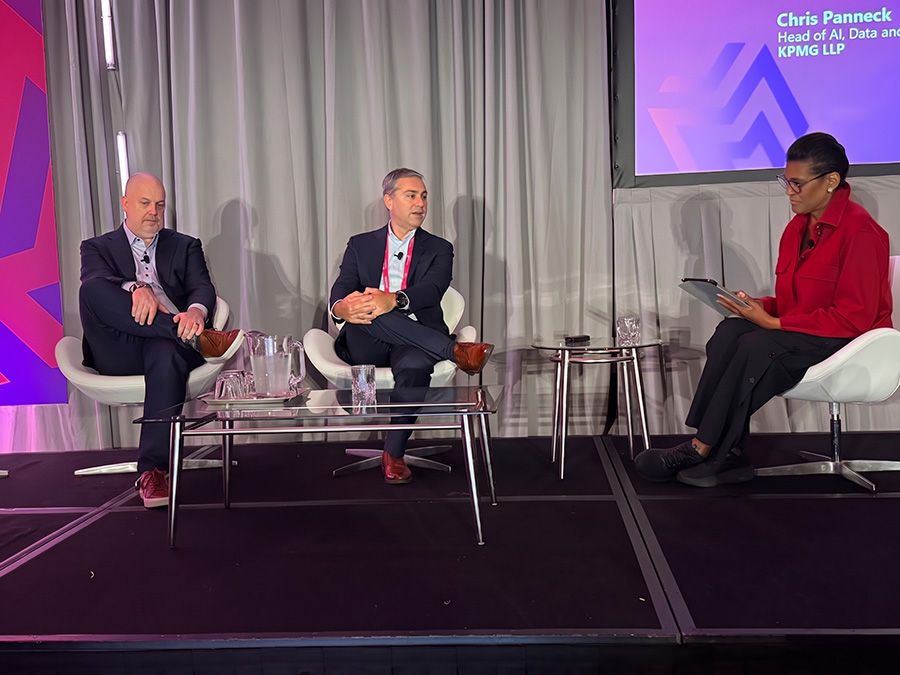
Sarquis outlined the criteria Santander uses to prioritize high-impact use cases across the enterprise. “We get to think about basically a meaningful customer need,” Sarquis said. “That is where it all starts. The promised land is basically to have extreme personalization of your customers. We are not there yet, but we are getting there.”
Sarquis added that the shift toward autonomous agents represents a major turning point for financial workflows. “Moving from AI assisting in individual tasks to suddenly AI orchestrating and executing workflows is a game changer for us, for the industry,” Sarquis stated. “AI now gives us the opportunity to organize based on customer intent. So now suddenly we can start looking at onboarding of the customer or lending experiences.”
Panneck addressed the technical challenge of managing non-deterministic models in an industry where precision is mandatory. “Determinism is the last mile of AI in many ways,” Panneck explained. “It is the element that allows us to expand AI into getting closer to the customer. The cost of getting it wrong gets more expensive the closer it gets to the customer.”
Panneck also pointed out that generative development tools are completely shifting the economics of legacy core modernization. “AI fundamentally changes the economics for most businesses in terms of what they have looked at in the past versus the future,” Panneck said. “The cost of building software is just rapidly decreasing and the speed is accelerating.”
Embedded SMB Lending: Two Opportunities, Not One
Moderated by Renton & Co Founder Peter Renton, this fireside chat featured Prashant Fuloria, CEO of Fundbox, examining how embedded platforms and machine learning models are resolving structural challenges in small-business finance. Fuloria pointed out that traditional underwriting economics have historically shut small businesses out of bank financing.

“There used to be a stat floating around a couple of years ago that the average bank spends something like $3,000 to $5,000 to underwrite a business,” Fuloria said. “If the loan is $50,000, then you are losing money on the loan right from the very beginning, regardless of the credit performance.”
By integrating directly with bookkeeping platforms such as QuickBooks, Fundbox utilizes rich ledger history to automate underwriting and dramatically lower origination overhead. When asked about modern AI applications, Fuloria noted that Fundbox separates core credit decisioning from data processing.
“The first area where we found LLMs (large language models) to be really helpful is not in the core decisioning itself, but in the classification and categorization of unstructured data,” Fuloria explained. “By utilizing LLMs in transaction data classification, we have improved our ability to identify other lenders inside of a business by 2x.”
Fuloria revealed that Fundbox is also deploying transformer architectures trained on structured numerical data to enhance risk assessments. “In our back-testing, we have seen about a 10% reduction in losses for the same approval, same line sizes, because of better risk scoring,” Fuloria said.
Fuloria emphasized that embedded distribution allows balance-sheet lenders to deploy capital efficiently within third-party SaaS ecosystems without having to build costly standalone acquisition channels.
Additional insights from MoneyLIVE North America are available in the Conference Coverage section on Finopotamus.com.


