
Momentum 2026: TruStage Chief Economist Provides Financial Forecast

By John San Filippo

At Corporate Central Credit Union’s Momentum 2026 conference in Madison, Wis., TruStage Chief Economist Steve Rick delivered an economic roadmap designed to help credit union executives frame upcoming annual business plans. Rick emphasized that understanding the macroeconomic landscape is fundamental to steering any credit union.
“What is a credit union? The essence of the credit union? We are basically money traders, right? We buy and we sell money. We take in deposits, pay a low rate, take that money, lend it out at a higher rate, live off the margin or the spread,” Rick explained. “So, we really have to figure out what’s going to go on with interest rates for the next year or two to see basically what’s going to happen to our savings growth, our loan growth, things like that.”
The Stance of Monetary Policy
Framing the discussion around the Federal Reserve’s dual mandate, Rick analogized the economy to a moving car where interest rate adjustments serve as the gas pedal or the brake. While low rates stimulated lending coming out of the pandemic, the fastest rate hikes in four decades brought the Fed funds rate to restrictive territory to tame inflation.
“Notice during this time I say the Fed accelerated the economy with these low rates, pressing on the accelerator. The Federal Reserve said, ‘You know what, the car’s going fast enough now.’ We actually had inflation during this time period hitting 9%. In my analogy, that’s like a car doing 90 miles an hour down the highway. So, the Fed says, ‘Hey, we’ve got to take our foot off the gas and hit the brake.”
Although the Fed has dialed back from its peak, the current 3.85% rate remains above the long-run neutral rate of 3.0%.
“People always ask me, hey Steve, what’s your current stance of monetary policy? And I say it’s modestly restrictive. It’s above the gold line, so the Fed’s pressing on the brake, but only by a little bit. They’re not pressing like they were a couple years ago at 5%. It’s 3.85%, so they are pressing.”
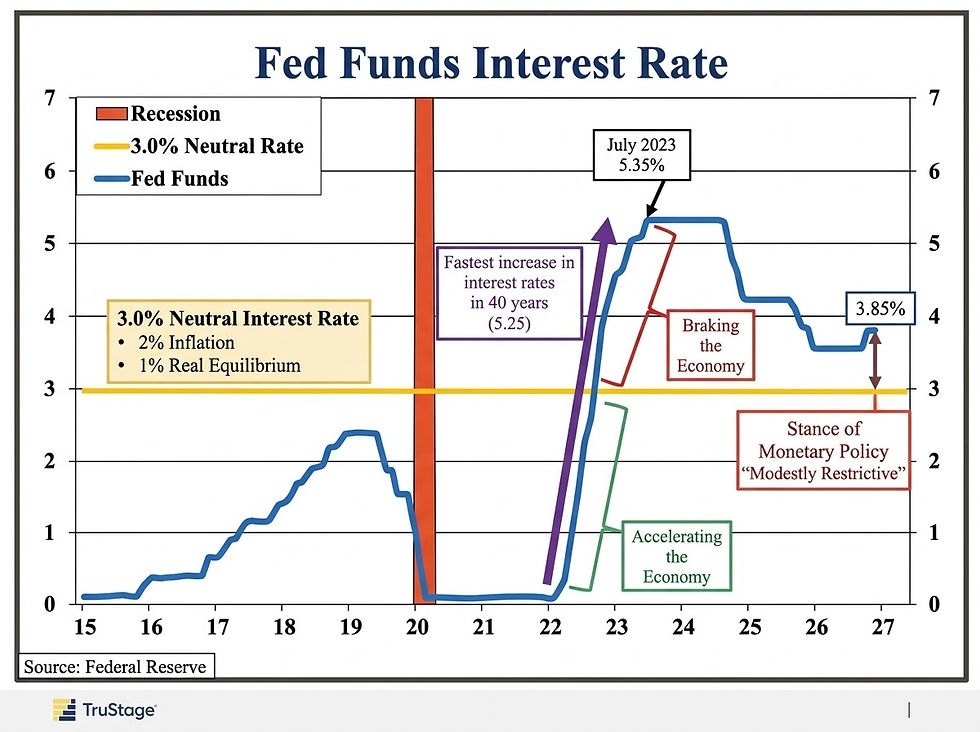
Looking ahead, Rick warned that inflation pressures – driven by tariffs, deglobalization, geopolitical conflicts, and tight labor supplies – mean rate hikes are likely not finished, with financial markets pricing in additional increases.
Productivity as the Economic Engine
Examining nationwide growth, Rick projected that U.S. economic output will expand near its natural 2.0% baseline. Historically, standard economic growth relies on two equal pillars: 1% labor force growth and 1% productivity gains. However, restricted immigration and border enforcement have essentially flattened labor pool expansion.
“Think of it this way. Say I took a pin and I popped this labor bubble,” he said, referring to one of his charts. “It’s basically gone. That means to have growth today of 2%, we need to have basically 2% productivity growth because there’s very little labor force growth.”
Rick then pointed to nonfarm labor productivity data as the single most encouraging chart in the presentation, showing an average growth rate of 2.6% over the past three years. “Every econ textbook I ever read said, if you want to understand the true health of an economy, look at its productivity growth. If the productivity numbers are strong, typically real incomes go up. People’s standard of living goes up.”

He attributed this surge to supply chain normalization, capital-for-labor substitution, aggressive business formation, hybrid work optimization, and widespread artificial intelligence adoption.
Credit Union Balance Sheets and Performance
Turning his focus to credit union balance sheets, Rick outlined how historical trends provide a reliable benchmark. “You know, I’ve been studying credit unions for about 35 years. I got data going back all the way to the 1930s. Basically, in the long run, credit unions grow their loans 7% a year. Deposits grow 7% a year. Capital 7% a year. That’s why I call it 777. It’s the sign of the credit union.”
Currently, credit union loan growth sits below that historical baseline at roughly 5.8%. Rick highlighted that the lending frenzy of 2022, which reached 19.1% growth, left credit unions with high amortization runoffs and severe delinquency challenges as pandemic supports expired. Commercial banks have temporarily outpaced credit unions by funding massive AI infrastructure and data center construction. However, Rick forecasts credit union loan growth to gradually recover toward 5.5% as originations in home equity and mortgages offset the runoff.
Despite muted loan and deposit expansion, Rick said the earnings forecast remains solid. He forecasts credit union return on assets (ROA) to reach 85 basis points through 2027, outpacing the 78-basis-point historical average. “The last couple of years were a little bit weak, high provisions for loan losses, things like that. But the next two years, we’re going to be above that. They’re going to be better years than normal when it comes to the bottom line.”

Rick stated that this profitability rebound will be supported by three primary operational tailwinds: widening net interest margins from elevated asset yields, declining operating expense ratios driven by workforce efficiencies and automation, and lower provision expenses as pandemic-era credit losses steadily taper off.


