How to Bring Home the Finovate Gold: Tips from a Two-Time “Best of Show” Winner

By John San Filippo
FinovateSpring 2026 was held in San Diego May 5-7. For those unfamiliar with the format, Finovate conferences offer the standard fare of keynotes and panel discussions. The focus of the three-day event, however, is to provide fintechs the opportunity to participate in a pitch contest. Each fintech is given seven minutes to demo their product, and winners are determined by audience vote.
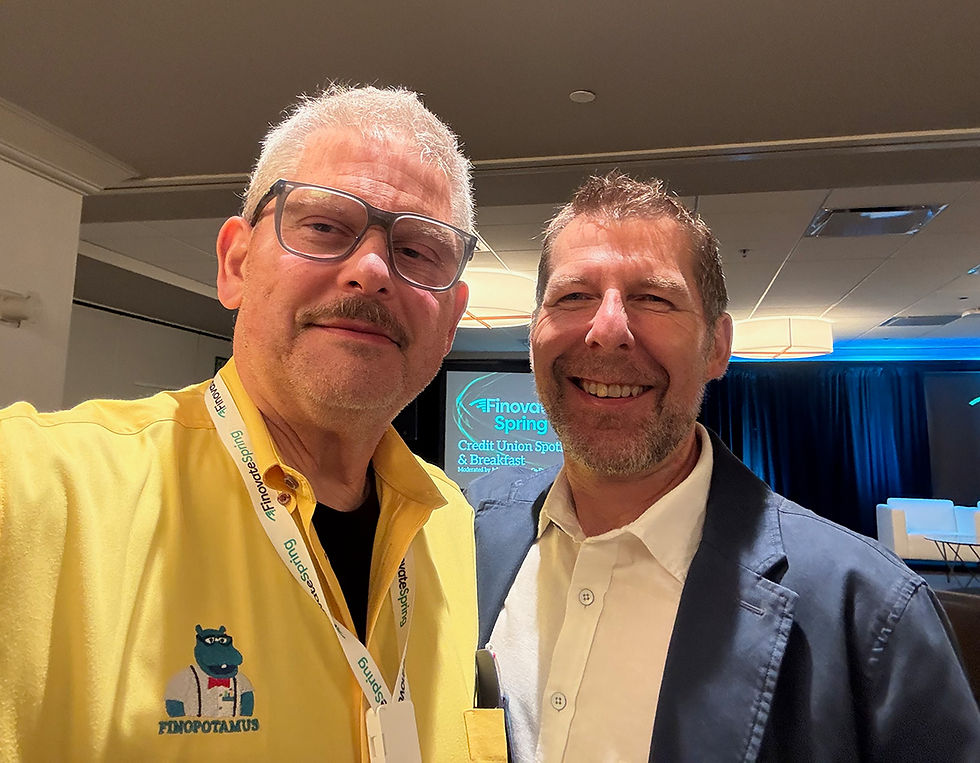
For the second year in a row, AI personalization platform provider Finalytics.ai captured one of the “Best of Show” awards. Finopotamus, a FinovateSpring media partner, caught up with Finalytics Chief Strategy Officer and pitchman Baron Conway to learn what advice he has for aspiring Finovate winners and why he believes every fintech needs to take credit unions seriously.
The Secrets to a Winning Demo
Winning a “Best of Show” award twice in a row is no small feat, especially in a field as crowded as FinovateSpring. For Conway, the success of Finalytics.ai stems from a refusal to demo mere concepts. Instead, the company focuses on tangible solutions for immediate industry problems.
“I think there’s an increasing realization and appreciation that the solution that we’re providing solves an immediate and ongoing problem that credit unions have,” Conway said. “It shows a clear path to growth, and it works because we’re not demoing a concept. We’re not demoing a prototype. We actually have live customers.”
This focus on reality extends to the technical execution of the pitch. While many presenters rely on canned videos or “sandbox” environments, Finalytics intentionally uses live client sites to prove their platform’s efficacy.
“We always demo using real clients because what better way is there to tell someone you’ve got a platform that works?” Conway explained. “Let me show you. And not only that, when we pull up a dashboard, even though we hide the brand name of the client, it’s real data.”
Conway offered a blunt reminder: A demo that fails technically is a near-permanent mark against the brand. “Make sure your demo works,” he noted. “The people who are seeing this in front of you are peers, potential customers, existing customers, investors, media, and press. And it gets recorded and it lives forever.”
Connecting Through Storytelling
Beyond the technical setup, Conway attributed much of his company’s success to how information is delivered. In a format where 150 companies might pitch over three days, features and benefits quickly become a blur. To stand out, a fintech must move beyond the “what” and focus on the “so what.”
“Think about your solution not in terms of the technology but approach it clearly from what is the problem you’re going to solve and what is the benefit you’re going to drive,” Conway suggested. “Don’t just get up and talk about technology. Don’t just talk about features and benefits because everyone talks about features and benefits.”
He emphasized that the most effective way to cut through the noise is to establish a human connection before diving into the data. “Everything you’re doing is a story,” Conway said. “You’re not talking at people; you’re talking to people or with people. Create the emotional response and then the logical, rational response will follow. But if you don’t get the emotional connection, everything else is really difficult.”
Why Credit Unions Are a Fintech Goldmine
For many fintechs, credit unions are often viewed as an afterthought – “banks with funny names.” Conway argued that this perspective is a massive strategic error for any company looking to gain a foothold in financial services.
“If you’re a fintech and you’re going into financial services, shame on you for not understanding the industry as a whole,” Conway said. “Within all of that, if you’re going to look into banking, you have to look into the credit union side of the world.”
He further explained that the unique value proposition of credit unions – their not-for-profit status – fundamentally changes the nature of the partnership. “Being not-for-profit changes the focus on how you want to engage your customer base,” he noted. “It changes how you operate as an organization. And for a fintech to be part of that journey and part of that story can be incredibly rewarding, not just financially, but emotionally and psychologically as well.”
Perhaps most importantly for startups, Conway pointed out that credit unions are often more agile and experimental than their larger retail banking counterparts.
“This is an industry that actually is innovating and is hungry for innovation and is willing to take calculated risks more so than a lot of others,” Conway said. “They realize that being smaller in scale, having a different financial structure, and having a different competitive set means they have no choice but to innovate. And so, you are going to get heard.”